Welcome to this site that shows works of art by Paul Benedict Brand, an artist whose training places him in the ’50s but whose endeavour took him into a world of his own.
Paul produced a substantial and intriguing body of artworks throughout his life.
Paul would have embraced the use of the internet to show his work, and it is with great pleasure that these images are now being made available for viewing on this platform.
He would love to know that people are looking at what he spent years constructing so carefully.
BIOGRAPHY
Take a visual journey through the artist’s life, tracing the experiences and influences that shaped his work.

Paul with brothers Andrew and Anthony [R – L], c. 1930.
During the Depression jobs were hard to find and the armed forces were recruiting vigorously. Although there is a strong naval background in the Brand family, Paul signed up with the RAF because of his great interest in aeroplanes and making model aircraft from his own designs. After a two-year apprenticeship principally in Milford Haven, Wales, his squadron was sent out to Iraq in 1937 to secure the oil pipe lines. In spite of Hibbanya being described as “the most godforsaken hell-hole in the entire world” by Roald Dahl in his autobiography, ‘Going Solo’, it was a posting that initially allowed Paul to exult in the hot, dry climate as off duty he could relish in the opportunities for swimming, sailing, water polo and athletics.
He also undertook several creative endeavours, setting up theatrical productions and taking black and white photographs, which started his career as an artist. But with the outbreak of war in 1939 everything changed and his squadron was stationed in Egypt. It is likely that they were involved in the battle for the desert – though it is not known what part Paul played as never talked about his experience, refusing his medals, he said because ‘those that deserved them weren’t there to receive them’. After two years there and in the Sudan, they were repatriated, entailing a long voyage by troop ship round the Cape and across to the western Atlantic to avoid German U-boats.
He married Dorothy in 1942 and they had three children, Paul, Michael and Judith. Sadly, things did not work out, and after four more years’ service in England, the onset of clinical depression resulted in a discharge from the RAF in 1946 with a grant to study Art. The immediate post-war years saw Paul leave the camera behind and devote himself to acquiring techniques, whilst working part-time as a night watchman at Westminster Abbey and during the 1948 London Olympics. After attending three art schools, and a teaching course at the University of London he used his qualifications to gain jobs as an art teacher.

Paul in Hibbaniya, c. 1938
Although now an art teacher he still took time to study and practice his own work. He submitted works to London Societies such as the R.I.B.A. and R.O.I. and also was associated with the Society for Education through Art, attending the Frenet conference at Mulhouse on their behalf. He found time to attend evening and part time courses at Central School of Art and the University of Education and Navigation at Dovercourt.
After leaving Canterbury School, where he had introduced Pottery and experimental media into the curriculum, he had a part time job as Art Therapist at Benenden Chest Hospital, where he designed the new Art and Pottery centre. Concurrently he lectured in Art History at Battersea College of Technology, ultimately introducing practical drawing and painting classes for their Liberal Studies.
He married Barbara, youngest daughter of a classicist, in 1960, and lived on a harbour launch on the Thames, where their first child was born. After several cold and wet winters, they decided to try their luck in a warmer country and opted for Greece, a painter’s paradise with regard to the light, but also as they both loved the classical tales of Ancient Greece.
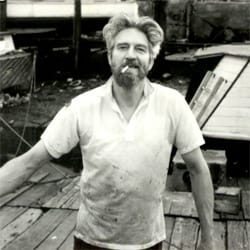
Paul on the jetty, c. 1959

Rowing across the Thames at Isleworth, c. 1959
In Greece they lived in Athens, where Paul continued to pot and paint and had his first one-man show in 1966, the year his youngest daughter was born. Moving onto the Island of Evvia (Euboia) Paul undertook many paintings of the locale and the locals. Whilst in Greece he planned the Art Educational/Recreation scheme for Raytheon, in Jiddah, Saudi Arabia, designed a water tower for Malaconda, and experimented with “pipe and block” work with particular relation to pre-fabricated housing.
However, in 1967, the Colonels seized power and the future felt very uncertain. Consequently, the family returned to England with all their possessions in a Bedford laundry van! Much of the space was taken up with paintings which formed the subject of an exhibition in Amsterdam, where they stopped on their return.

Greek farm Cart, Malaconda, oil on canvas, 1965, not for sale.
On returning to England, he continued to teach and had his own studio, exhibiting locally, submitting work to London Societies, including the RA, NEAC and the USoA. (Royal Academy, New English Art Club and the United Society of Artists.)
His drive to explore pushed him to pursue his own creativity and for nearly forty years he worked daily in the studio, becoming increasingly reclusive. Influences from his life experiences are visible in the works he produced – the influence of the Church, military service and culturally from literature and music. He was a great observer both of life and of artefact and his travels provided him with an arsenal of material, informing and appearing in his work in some quite surprising ways. His subject matter extended from life in all forms – animals, plants, costumes, textiles, boats, architectural studies, landscapes and portraits to illustrating stories from classical themes from music, theatre and art.

Eucalyptus Trees, Eretria, oil on board, 1971, on loan.
He used many legends, myths, and biblical stories as a basis for composition, as countless drawings, sketches and finished paintings show. His appreciation of the dramatic can be seen in his designs for theatre and in illustrations of tragedies. He spent long hours researching the stories from myth and legend to create works of art. His love of music, particularly Berlioz and other story-tellers, in particular gave rise to illustrative paintings, notably “The Dance of the Capulets” and the “Fantastic Symphony”.

The Feast of the Capulets, oil on board, c. 1968, sold.
His last finished work, “American Diplomacy” in oil, acrylic and charcoal, on canvas, using the basic form of the hexagon as a starting point, was a cry from the heart. His time in Iraq so many years before had made a great impression on him. Once before he had made a poster connected with the war in Uganda, but politics was rarely visible in his work. But the news of the invasion of Iraq motivated him to protest in the only way he could.
In 2005 Paul suffered a heart attack from which he didn’t fully recover, and after which he did not paint. Even before this he found it difficult to explain his purpose, but several times he said that his aim was for people to see something – preferably beautiful – in a picture that wasn’t about ‘likeness’ (which he felt was the work of the camera), but about how paint is used in the construction of an image.

‘My Guernica’ or ‘American Diplomacy’, oil on canvas, 2004
BIOGRAPHY
Take a visual journey through the artist’s life, tracing the experiences and influences that shaped his work.
Childhood
Paul with brothers Andrew and Anthony [R – L], c. 1930.
Armed Forces
During the Depression jobs were hard to find and the armed forces were recruiting vigorously. Although there is a strong naval background in the Brand family, Paul signed up with the RAF because of his great interest in aeroplanes and making model aircraft from his own designs. After a two-year apprenticeship principally in Milford Haven, Wales, his squadron was sent out to Iraq in 1937 to secure the oil pipe lines. In spite of Hibbanya being described as “the most godforsaken hell-hole in the entire world” by Roald Dahl in his autobiography, ‘Going Solo’, it was a posting that initially allowed Paul to exult in the hot, dry climate as off duty he could relish in the opportunities for swimming, sailing, water polo and athletics.
He also undertook several creative endeavours, setting up theatrical productions and taking black and white photographs, which started his career as an artist. But with the outbreak of war in 1939 everything changed and his squadron was stationed in Egypt. It is likely that they were involved in the battle for the desert – though it is not known what part Paul played as never talked about his experience, refusing his medals, he said because ‘those that deserved them weren’t there to receive them’. After two years there and in the Sudan, they were repatriated, entailing a long voyage by troop ship round the Cape and across to the western Atlantic to avoid German U-boats.
He married Dorothy in 1942 and they had three children, Paul, Michael and Judith. Sadly, things did not work out, and after four more years’ service in England, the onset of clinical depression resulted in a discharge from the RAF in 1946 with a grant to study Art. The immediate post-war years saw Paul leave the camera behind and devote himself to acquiring techniques, whilst working part-time as a night watchman at Westminster Abbey and during the 1948 London Olympics. After attending three art schools, and a teaching course at the University of London he used his qualifications to gain jobs as an art teacher.
Paul in Hibbaniya, c. 1938
The New Start
Although now an art teacher he still took time to study and practice his own work. He submitted works to London Societies such as the R.I.B.A. and R.O.I. and also was associated with the Society for Education through Art, attending the Frenet conference at Mulhouse on their behalf. He found time to attend evening and part time courses at Central School of Art and the University of Education and Navigation at Dovercourt.
After leaving Canterbury School, where he had introduced Pottery and experimental media into the curriculum, he had a part time job as Art Therapist at Benenden Chest Hospital, where he designed the new Art and Pottery centre. Concurrently he lectured in Art History at Battersea College of Technology, ultimately introducing practical drawing and painting classes for their Liberal Studies.
He married Barbara, youngest daughter of a classicist, in 1960, and lived on a harbour launch on the Thames, where their first child was born. After several cold and wet winters, they decided to try their luck in a warmer country and opted for Greece, a painter’s paradise with regard to the light, but also as they both loved the classical tales of Ancient Greece.
Paul on the jetty, c. 1959
Rowing across the Thames at Isleworth, c. 1959
Years in Greece
In Greece they lived in Athens, where Paul continued to pot and paint and had his first one-man show in 1966, the year his youngest daughter was born. Moving onto the Island of Evvia (Euboia) Paul undertook many paintings of the locale and the locals. Whilst in Greece he planned the Art Educational/Recreation scheme for Raytheon, in Jiddah, Saudi Arabia, designed a water tower for Malaconda, and experimented with “pipe and block” work with particular relation to pre-fabricated housing.
However, in 1967, the Colonels seized power and the future felt very uncertain. Consequently, the family returned to England with all their possessions in a Bedford laundry van! Much of the space was taken up with paintings which formed the subject of an exhibition in Amsterdam, where they stopped on their return.
Greek farm Cart, Malaconda, oil on canvas, 1965, not for sale.
England
On returning to England, he continued to teach and had his own studio, exhibiting locally, submitting work to London Societies, including the RA, NEAC and the USoA. (Royal Academy, New English Art Club and the United Society of Artists.)
His drive to explore pushed him to pursue his own creativity and for nearly forty years he worked daily in the studio, becoming increasingly reclusive. Influences from his life experiences are visible in the works he produced – the influence of the Church, military service and culturally from literature and music. He was a great observer both of life and of artefact and his travels provided him with an arsenal of material, informing and appearing in his work in some quite surprising ways. His subject matter extended from life in all forms – animals, plants, costumes, textiles, boats, architectural studies, landscapes and portraits to illustrating stories from classical themes from music, theatre and art.
Eucalyptus Trees, Eretria, oil on board, 1971, on loan.
Myths
He used many legends, myths, and biblical stories as a basis for composition, as countless drawings, sketches and finished paintings show. His appreciation of the dramatic can be seen in his designs for theatre and in illustrations of tragedies. He spent long hours researching the stories from myth and legend to create works of art. His love of music, particularly Berlioz and other story-tellers, in particular gave rise to illustrative paintings, notably “The Dance of the Capulets” and the “Fantastic Symphony”.
The Feast of the Capulets, oil on board, c. 1968, sold.
Last Work
His last finished work, “American Diplomacy” in oil, acrylic and charcoal, on canvas, using the basic form of the hexagon as a starting point, was a cry from the heart. His time in Iraq so many years before had made a great impression on him. Once before he had made a poster connected with the war in Uganda, but politics was rarely visible in his work. But the news of the invasion of Iraq motivated him to protest in the only way he could.
In 2005 Paul suffered a heart attack from which he didn’t fully recover, and after which he did not paint. Even before this he found it difficult to explain his purpose, but several times he said that his aim was for people to see something – preferably beautiful – in a picture that wasn’t about ‘likeness’ (which he felt was the work of the camera), but about how paint is used in the construction of an image.
‘My Guernica’ or ‘American Diplomacy’, oil on canvas, 2004
TECHNIQUE
Always stretching himself to experiment, Paul searched for fresh and original ways to communicate through imagery, consciously avoiding predictable methods of producing work.
His principle concern was composition, the placing of form and tone within a frame would determine the colours and matters depicted – he was determined to give a painting balance and harmony with an aesthetic influenced by classical and renaissance theory, notably the golden mean.

Read more
At the same time, he was playing with the materials to create an illusion of a third dimension on the painting surface, not just by manipulating paint but also by selecting different surfaces such as canvas, board, and hessian, integrating the textures of the materials into his design. He wanted to give viewers a visual feast, and for them to spend time absorbing the information presented.
His work developed from realistic figurative painting to a more exciting style using colour in a bold new way. Always interested in colour theory he developed his “squares” technique which gives the paintings an almost pixellated effect but predating digital images by two decades. At first, he painted every square the same size, but soon expanded this and loosened up and combined it with conventional painting, and also with other geometric shapes, notably the hexagon. Another key area was in the application of paint to the surface – for a period of about ten years he experimented with applying paint not with a brush but by running cog wheels as rollers through the paint, building up layers of colour which added texture and movement to the image.
As well as painting in oil, acrylic and watercolours, Paul was interested in many other art forms, notably mosaic, fresco, lino and woodcuts. He had earlier illustrated books, and some of his later paintings were more in the way of illustration, notably “Peer Gynt”. To make the mosaic “The Adoration of the Shepherds” he made tesserae, some from clay, and some from glass which he cut to fit, repurposing found materials as he has with other works. For the frescoes, having no suitable wall to work on he mixed a lime wash solution which he applied to wood, making them as portable as the other works.
He was also keen on pottery and at one time he made his own wheel. However, while many crafts caught his attention for weeks or months at a time, he would always return to painting.
VIDEO
Here are a series of studio videos offering insight into the artist’s process, as he reflects on his work while painting.
Part I: The studio
Here the artist is filmed working on his ‘last’ painting.
Part II: Work in progress
Here the artist is describing his compositional choices.
Welcome to this online exhibition – explore the art and works, where his ideas and experiences come fully to life.
This website is currently being updated so please check back regularly.
